Did Vaporwave Ever Exist?
The answer holds a great deal of tension: as a musical genre, it physically exists; but the world it depicts never existed.
It never “lived” in the physical world; it merely wandered as a “ghost” within the internet.
I. Forgotten Cassettes and Corrupted MP3 Files
It does exist.
This unique cultural genre was born in internet communities like Tumblr and Reddit in the early 2010s. Its name borrows from the computer term “Vaporware,” referring to software or hardware that is heavily advertised but never actually released. This name serves as a direct metaphor for the genre’s core themes of unfulfilled promises and essential “emptiness.”
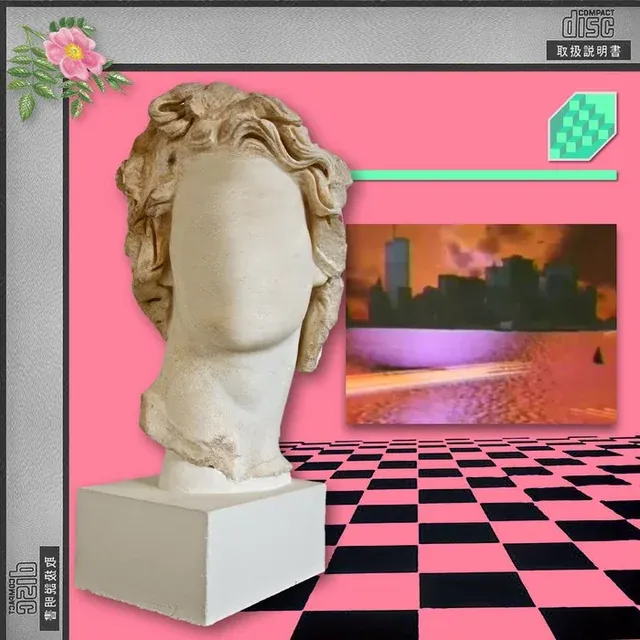
Although the genre was not created by a single person, three key figures established its basic paradigms. In 2010, Daniel Lopatin released Eccojams Vol.1, laying the auditory foundation of “slowing down, looping, and aging”; the following year, James Ferraro established the satirical core regarding consumerism and cheap technology with Far Side Virtual; finally, Macintosh Plus’s Floral Shoppe established the visual totem with its classic pink bust of Helios (David), formally pushing this style to the masses.
In terms of creative logic, this is a typical form of “textual poaching,” essentially an “autopsy and reassembly” of past sounds. Producers dive into the cultural ruins of the 80s and 90s, excavating functional musical materials like Muzak, weather channel background music, or City Pop, and recreating them like stitching together a Frankenstein monster. Through extreme slowing, pitch-shifting, and reverb processing, they create an auditory effect akin to an old Walkman running out of battery or a cassette tape jamming, stripping the original tracks of their vitality and rendering them into a hazy state of “near-death” or “sleepwalking.”
II. The Dislocation of “Time” and the Fabrication of “Space”
The ghost of a “dead future.”
From a temporal dimension, this genre embodies the concept of “Hauntology” proposed by Mark Fisher—the mourning of a “cancelled future” that we never truly arrived at. The 80s and 90s scenes it constructs (often Tokyo or Hong Kong) are filled with optimistic promises of a technological utopia. However, when young people in the 21st century look back, they find that this promise was never fulfilled; high technology has brought anxiety rather than liberation. Therefore, this emotion is not nostalgia for real history (the past that included a gritty reality), but a longing for that historical moment when we “believed tomorrow would be better”—an extreme manifestation of “Anemoia” (nostalgia for a time one has never known).
In the spatial dimension, Adam Harper describes it as “pop-art of the virtual plaza,” constructing a unique aesthetic based on “non-places.” It simulates transition spaces constructed by consumerism, such as shopping malls, elevators, and airport terminals. These places, which are cold and functional in reality, are alienated here into sacred “spiritual sanctuaries.” The auditory experience is like “looping a happy radio broadcast from 30 years ago in an empty shopping mall at midnight”—a happiness that appears particularly eerie and sorrowful because no one is listening, creating an atmosphere of solitude.
In the ontological dimension, this is a “simulacrum” borrowing from Jean Baudrillard’s view: a “copy without an original.” It is replete with “Cyber-Orientalism” elements—such as Japanese kana and Traditional Chinese characters—which are not authentic linguistic expressions but a “Hyperreality” constructed by the Western gaze through internet filters. For creators, these characters are more like exotic decorative symbols used to build an ideal state in a parallel world, rather than a reflection of reality.
III. “Antidote” to the Modern Dilemma?
Why would a group of young people born after 2010 suddenly become obsessed with “discarded music” from the 1980s?
On an economic level, this musical form acts as a medium for “electronic necromancy.” Facing the realities of economic stagnation and class solidification, the younger generation seeks psychological compensation by listening to these materials, largely sampled from Japan’s bubble economy era. This is not just listening to music, but a spiritual sustenance, allowing people to “soul travel” back to an era where money flowed smoothly, material goods were abundant, and hope was plentiful, reliving the prosperity of the past in an illusion.
At the same time, it is also a cultural resistance against modern “accelerationism.” Modern society imposes demands of “speed,” “efficiency,” and “always-on” connectivity, trapping individuals in Max Weber’s “iron cage” of rationality. The core of Vaporwave lies precisely in “deceleration”; it creates a “time detached from time.” In this unique space, the originally unstoppable pace of progress is intentionally disrupted, allowing exhausted urbanites to detach from endless competition and regain the right to “daydream.”
IV. A Life Philosophy
Vaporwave is not just nostalgia; it offers a new philosophy of life.
This aesthetic embodies a unique “digital Wabi-Sabi.” Against the backdrop of mainstream aesthetics pursuing “high definition” and perfection, it goes the opposite way, appreciating the “wear and tear of data.” The compression artifacts of MP3s, the snow of VHS tapes, and the crash screens of Windows 95 are no longer seen as glitches here, but are viewed as the “patina” and naturally growing “moss” of the digital world, rich with the sense of time. This aesthetic tendency is essentially “dermabrasion” for the overly harsh and clear digital reality, polishing sharp modern life until it is soft and hazy.
Simultaneously, it constructs a “gentle eschatology.” Unlike the violent and dark endings in traditional cognition, the “post-human” scene depicted here is serene, pink, and even accompanied by imagery of dolphins. In this imagination, even if human civilization has ended, the escalators in the mall are still running, and holographic advertisements are still flickering lonely. This is a kind of “Cyber-Stoicism” that cuts off the obsession with linear “progress,” locking time forever in the most comfortable and pleasant second through an infinite Loop, allowing people to immerse themselves in a purposeless happiness.
Final Thoughts
If one must answer “Where does Vaporwave exist?”, the answer is: It exists in the cracks of reality.
It is a spiritual creation of internet natives facing the dual dilemma of “stagnation of growth” and “technological acceleration.” They utilize those “expired future materials”—the illusions of the 80s bubble economy—to construct an “electronic utopia.”
Its ultimate value lies in providing an extremely elegant “exit mechanism”: It tells us that you don’t have to participate in this game of infinite growth; you can hide in that looping cycle, on the ruins of the future, watching the eternal pink sunset, even if only for three minutes.
References
Born, G., & Haworth, C. (2017). From Microsound To Vaporwave: Internet-Mediated Music, Online Methods, And Genre. Music and Letters, 98(4), 601-647.
Harper, A. (2012). Comment: Vaporwave and the pop-art of the virtual plaza. Dummy. Retrieved from https://dummymag.com/news/adam-harper-vaporwave
Tanner, G. (2016). Babbling Corpse: Vaporwave And The Commodification Of Ghosts. Winchester, UK: Zero Books.
Whelan, A., & Nowak, R. (2018). Vaporwave Is (Not) a Critique of Capitalism: Genre Work in An Online Music Scene. Open Cultural Studies, 2(1), 451-462.
Boym, S. (2001). The Future of Nostalgia. New York: Basic Books.
Hebdige, D. (1979). Subculture: The Meaning of Style. London: Routledge.
Jameson, F. (1991). Postmodernism, or, The Cultural Logic of Late Capitalism. Durham: Duke University Press.
Jenkins, H. (1992). Textual Poachers: Television Fans and Participatory Culture. New York: Routledge.